Introduction
In the present era with a rapidly changing educational scenario, the role of teachers and teaching are changing fast wherein he is concerned with the responsibility of promoting fruitful learning and stimulating the students by adopting appropriate strategies. During the last two decades many new methods of teaching and techniques have been developed, tested, modified and adopted to different kind of learning situations. Concept mapping is one of the effective technique among innovative methods of teaching. Concept Mapping is a tool for assisting and enhancing many of the types of thinking and learning that we are required to do at learning situation. It has subsequently been used as a tool to increase meaningful learning in the sciences and other subjects as well as to represent the expert knowledge of individuals and teams in education, government and business
The technique of concept mapping was developed by Joseph D Novak and his research team at Cornell University in the1960s as a means of representing the emerging science knowledge of students. Concept maps have their origin in the learning movement called constructivism. In particular, constructivists hold that prior knowledge is used as a framework to learn new knowledge. Novak’s work was based on the theories of David Ausubel (assimilation theory), who stressed the importance of prior knowledge in being able to learn about new concepts. According to Novak meaningful learning involves the assimilation of new concepts and propositions into existing cognitive structures.
There are four major categories of concept maps. These are distinguished by their different format for representing information.
People often confuse rote learning and meaningful learning with teaching approaches that can vary on a continuum from direct presentation of information (which may be conceptually obscure or conceptually explicit) to autonomous discovery approaches where the learner perceives the regularities and constructs her/his own concepts. Both direct presentation and discovery teaching methods can lead to highly rote or highly meaningful learning by the learner, depending on the disposition of the learner and the organization of the instructional materials. These distinctions are
.
Summary
In the present era with a rapidly changing educational scenario, the role of teachers and teaching are changing fast wherein he is concerned with the responsibility of promoting fruitful learning and stimulating the students by adopting appropriate strategies. During the last two decades many new methods of teaching and techniques have been developed, tested, modified and adopted to different kind of learning situations. Concept mapping is one of the effective technique among innovative methods of teaching. Concept Mapping is a tool for assisting and enhancing many of the types of thinking and learning that we are required to do at learning situation. It has subsequently been used as a tool to increase meaningful learning in the sciences and other subjects as well as to represent the expert knowledge of individuals and teams in education, government and business
The technique of concept mapping was developed by Joseph D Novak and his research team at Cornell University in the1960s as a means of representing the emerging science knowledge of students. Concept maps have their origin in the learning movement called constructivism. In particular, constructivists hold that prior knowledge is used as a framework to learn new knowledge. Novak’s work was based on the theories of David Ausubel (assimilation theory), who stressed the importance of prior knowledge in being able to learn about new concepts. According to Novak meaningful learning involves the assimilation of new concepts and propositions into existing cognitive structures.
Meaning
“Concept maps are two-dimensional representations of cognitive structures showing the hierarchies and the interconnections of concepts involved in a discipline or a sub discipline” (Martin 1994:11)
Concept Mapping
A concept map presents the relationships among a set of connected concepts and ideas. They are special forms of diagrams for exploring knowledge and for gathering and sharing information; they illustrate meaningful relationships between concepts.
Concept mapping is a technique for representing knowledge in graphs. Knowledge graphs are networks of concepts. Networks consist of nodes (points/vertices) and links (arcs/edges). Nodes represent concepts and links represent the relations between concepts. Concepts and sometimes links are labeled. Links can be non-, uni- or bi-directional. Concepts and links may be categorized, they can be simply associative, specified or divided in categories such as causal or temporal relations.
An example of concept map in chemistry
Purpose of concept mapping
Concept mapping is a type of knowledge representation Representing knowledge in the visual format of a concept map allows one to gain an overview of a domain of knowledge. Because the nodes contain only a keyword or a short sentence, more interpretation is required of the reader, but this may be positive. Concept mapping can be used for several purposes - to generate ideas (brain storming, etc.);
- to design a complex structure (long texts, hypermedia, large web sites, etc.);
- to communicate complex ideas;
- to aid learning by explicitly integrating new and old knowledge;
- to assess understanding or diagnose misunderstanding.
Advantages of concept mapping
Visual representation has several advantages:
--Visual symbols are quickly and easily recognized;
--Minimum use of text makes it easy to scan for a word, phrase, or the general idea; and
--Visual representation allows for development of a holistic understanding that words alone cannot convey.
Applications of concept mapping
(1) Creativity Tool: Drawing a concept map can be compared to participating in a brainstorming session. As one puts ideas down on paper without criticism, the ideas become clearer and the mind becomes free to receive new ideas. These new ideas may be linked to ideas already on the paper, and they may also trigger new associations leading to new ideas
.
(2) Hypertext Design Tool: As the World Wide Web becomes an increasingly powerful and ubiquitous medium for disseminating information, writers must move from writing text in linear fashion to creating hypertext documents with links to other documents.
(4) Learning Tool: Novak's original work with concept mapping dealt with learning. Constructivist learning theory argues that new knowledge should be integrated into existing structures in order to be remembered and receive meaning. Concept mapping stimulates this process by making it explicit and requiring the learner to pay attention to the relationship between concepts.
(5) Assessment Tool: Concept maps can also be used as assessment tools. The research team around Joseph Novak at Cornell found that an important by-product of concept mapping is its ability to detect or illustrate the "misconceptions" learners may have as explanations of content matter. The conceptions students may have are often incomplete and deficient leading to misunderstanding of instruction.
Steps in concept mapping
Concept mapping is a structured process, focused on a topic or construct of interest, involving input from one or more participants, that produces an interpretable pictorial view (concept map) of their ideas and concepts and how these are interrelated. Concept mapping helps people to think more effectively as a group without losing their individuality.
1. Preparation Step.
2. Generation Step
3. Structuring Step
4. Representation Step
5. Interpretation of maps
6. Utilization Step
Kinds of concept mapsThere are four major categories of concept maps. These are distinguished by their different format for representing information.
1. Spider concept map
The “spider" concept map is organized by placing the central theme or unifying factor in the center of the map. Outwardly radiating sub-themes surround the center of the map.
2.Hierarchy concept map
The hierarchy concept map presents information in a descending order of importance. The most important information is placed on the top. Distinguishing factors determine the placement of the information.
3. Flowchart concept map
The flowchart concept map organizes information in a linear format.
4. Systems concept map
The systems concept map organizes information in a format which is similar to a flowchart with the addition of 'INPUTS' and 'OUTPUTS'. Also known as a Data Flow Diagram.
Psychological foundations concept mapping
The question sometimes arises as to the origin of our first concepts. These are acquired by children during the ages of birth to three years, when they recognize regularities in the world around them and begin to identify language labels or symbols for these regularities. This early learning of concepts is primarily a discovery learning process, where the individual discerns patterns or regularities in events or objects and recognizes these as the same regularities labeled by older persons with words or symbols. This is a phenomenal ability that is part of the evolutionary heritage of all normal human beings. After age 3, new concept and propositional learning is mediated heavily by language, and takes place primarily by a reception learning process where new meanings are obtained by asking questions and getting clarification of relationships between old concepts and propositions and new concepts and propositions. This acquisition is mediated in a very important way when concrete experiences or props are available; hence the importance of “hands-on” activity for science learning with young children, but this is also true with learners of any age and in any subject matter domain.
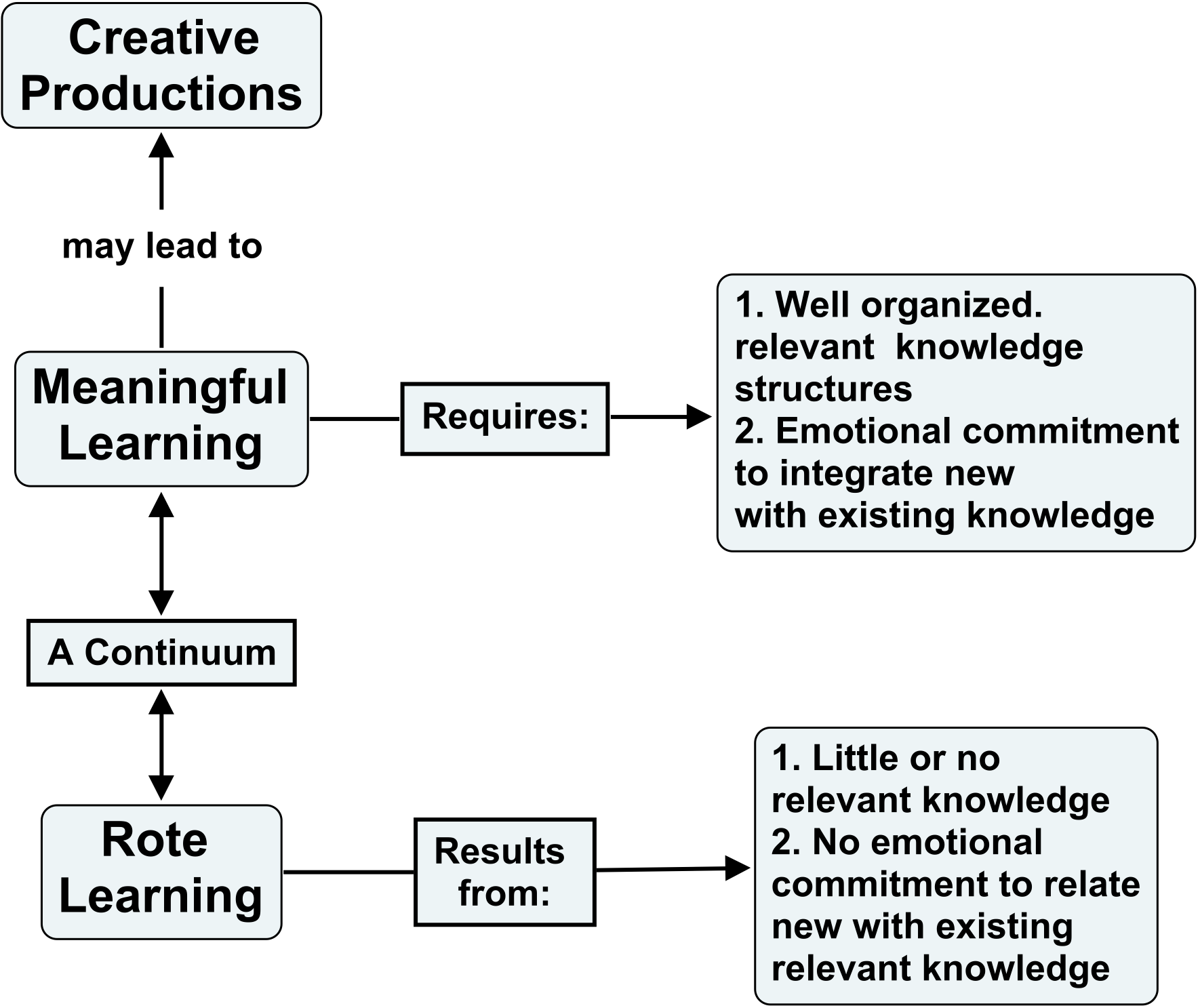
Ausubel made the very important distinction between rote learning and meaningful learning. Meaningful learning requires three conditions:
- The material to be learned must be conceptually clear and presented with language and examples relatable to the learner’s prior knowledge. Concept maps can be helpful to meet this condition, both by identifying large general concepts held by the learner prior to instruction on more specific concepts, and by assisting in the sequencing of learning tasks though progressively more explicit knowledge that can be anchored into developing conceptual frameworks.
- The learner must possess relevant prior knowledge. This condition can be met after age 3 for virtually any domain of subject matter, but it is necessary to be careful and explicit in building concept frameworks if one hopes to present detailed specific knowledge in any field in subsequent lessons. We see, therefore, that conditions (1) and (2) are interrelated and both are important.
- The learner must choose to learn meaningfully. The one condition over which the teacher or mentor has only indirect control is the motivation of students to choose to learn by attempting to incorporate new meanings into their prior knowledge, rather than simply memorizing concept definitions or propositional statements or computational procedures. The indirect control over this choice is primarily in instructional strategies used and the evaluation strategies used. Instructional strategies that emphasize relating new knowledge to the learner’s existing knowledge foster meaningful learning. Evaluation strategies that encourage learners to relate ideas they possess with new ideas also encourage meaningful learning.These ideas are shown in Figure 1.
Figure 1. Learning can vary from hightly rote to highly meaningful. Creativity results from very high levels of meaningful learning.
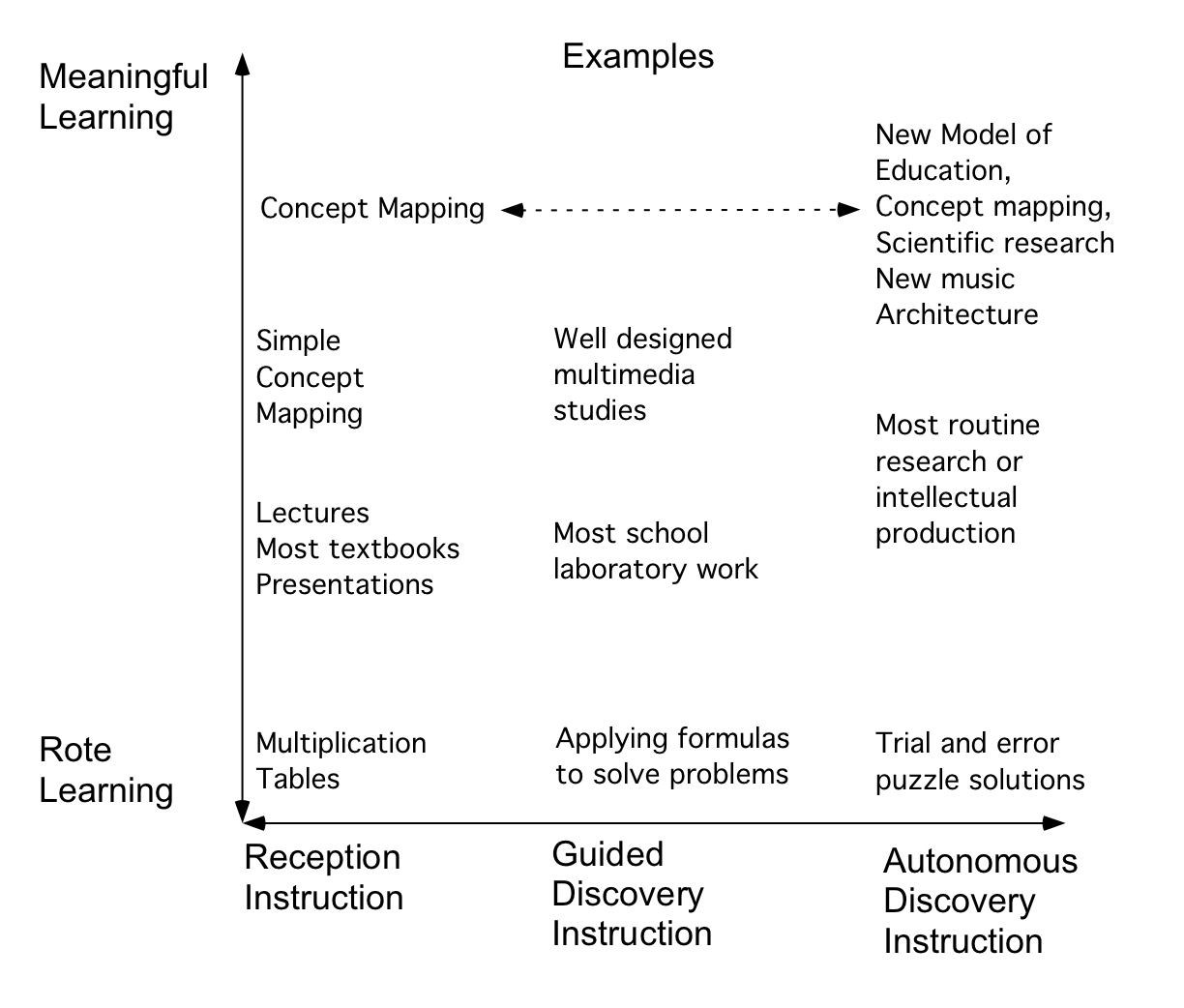
People often confuse rote learning and meaningful learning with teaching approaches that can vary on a continuum from direct presentation of information (which may be conceptually obscure or conceptually explicit) to autonomous discovery approaches where the learner perceives the regularities and constructs her/his own concepts. Both direct presentation and discovery teaching methods can lead to highly rote or highly meaningful learning by the learner, depending on the disposition of the learner and the organization of the instructional materials. These distinctions are
.
Figure 2. The Rote-Meaningful learning continuum is not the same as the Reception-Discovery instructional continuum.
Epistemological Foundations of Concept Maps
Concept as a perceived regularity (or pattern) in events or objects, or records of events or objects, designated by label. It is coming to be generally recognized now that the meaningful learning processes described above are the same processes used by scientists and mathematicians, or experts in any discipline, to construct new knowledge. In fact, Novak has argued that new knowledge creation is nothing more than a relatively high level of meaningful learning accomplished by individuals who have a well organized knowledge structure in the particular area of knowledge, and also a strong emotional commitment to persist in finding new meanings (Novak, 1977, 1993, 1998). Epistemology is that branch of philosophy that deals with the nature of knowledge and new knowledge creation. There is an important relationship between the psychology of learning, as we understand it today, and the growing consensus among philosophers and epistemologists that new knowledge creation is a constructive process involving both our knowledge and our emotions or the drive to create new meanings and new ways to represent these meanings. Learners struggling to create good concept maps are themselves engaged in a creative process, and this can be challenging, especially to learners who have spent most of their life learning by rote. Rote learning contributes very little at best to our knowledge structures, and therefore cannot underlie creative thinking or novel problem solving.
Concept mapping is a technique for representing the structure of information visually. There are several uses for concept mapping, such as idea generation, design support, communication enhancement, learning enhancement, and assessment. Concept maps are special forms of diagrams for exploring knowledge and for gathering and sharing information;. Concept mapping strategy in teaching allows recalling, remembering and effectively managing large chunks of information in one time.

No comments:
Post a Comment